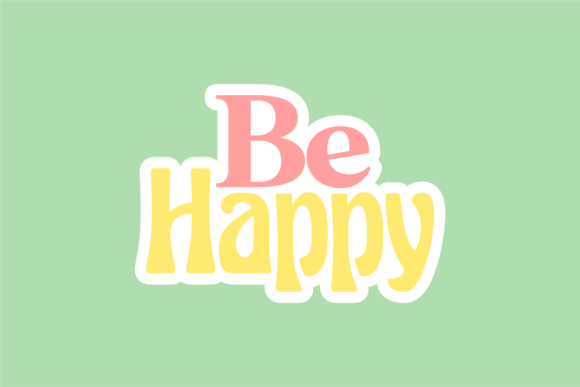
Back to School Typography Be Happy
Typography plays a quiet but decisive role in educational and promotional design—especially during the back-to-school season. Back to School Typography Be Happy is a ready-to-use, professionally crafted typographic asset designed for clarity, warmth, and visual consistency. It’s not a font family or a template pack—it’s a single, focused typographic composition centered around the phrase “Be Happy,” styled with intentional spacing, weight balance, and seasonal relevance. Its value lies less in novelty and more in execution: clean lines, balanced proportions, and immediate usability across digital and print contexts.
What You Actually Get—and Why Format Variety Matters
The package delivers six distinct file formats on a consistent 1920px × 1280px canvas: one AI (Adobe Illustrator), one EPS, one SVG, one DXF, one JPG, and one PNG. This breadth isn’t arbitrary—it reflects real-world production needs.
- AI and EPS files preserve vector scalability and layer integrity, making them ideal for designers who need to adjust individual letterforms, recolor elements, or integrate the composition into larger layouts without quality loss.
- SVG supports responsive web use—think hero banners, email headers, or LMS dashboard graphics—where crisp rendering at any screen size is non-negotiable.
- DXF serves niche but practical applications: educators using vinyl cutters for classroom signage, makers creating custom chalkboard decals, or small business owners producing physical back-to-school merchandise like tote bags or notebooks.
- JPG and PNG offer quick deployment—PNG with transparent background for overlays on photos or presentations; JPG for lightweight sharing, social media posts, or internal team briefs where vector editing isn’t required.
This multi-format approach avoids forcing users into a single workflow. A freelance graphic designer can open the AI file and modify kerning for a client’s brand guidelines. A school communications coordinator can drop the PNG into Canva and pair it with a photo of students returning to class. A small print shop owner can import the DXF directly into cutting software. The flexibility reduces friction—not just in editing, but in decision-making.
Design Quality and Visual Functionality
The composition avoids decorative excess. Letters are evenly spaced, with subtle but deliberate variations in stroke weight that add rhythm without compromising legibility. “Be Happy” reads clearly at both thumbnail size and full-screen display. The design leans into positivity without resorting to clichéd smiley faces or cartoonish elements—making it appropriate for academic institutions, tutoring services, edtech platforms, and even wellness-focused educators emphasizing emotional readiness alongside academic preparation.
Color is intentionally neutral in the base files (typically black or grayscale), allowing users to apply their own palette without hue conflicts. That choice supports accessibility testing—designers can verify contrast ratios against background colors before finalizing a layout. It also means the typography adapts cleanly to dark-mode interfaces or printed materials on off-white paper stock.
Practical Use Cases Across Roles
Professionals don’t adopt assets based on aesthetics alone—they assess fit within existing systems and constraints. Here’s how Back to School Typography Be Happy functions in actual workflows:
- Educators and administrators use the SVG or PNG in weekly newsletters, Google Slides welcome decks, or printed hallway posters reinforcing a supportive learning environment. The phrase aligns with social-emotional learning (SEL) initiatives without requiring custom copywriting.
- Freelance designers and agencies incorporate the AI file into branded campaign kits for clients in education-adjacent sectors—test prep companies, after-school programs, or university continuing education departments. Its clean structure holds up when scaled down for social avatars or enlarged for trade show banners.
- Small business owners selling back-to-school supplies or personalized stationery use the DXF to cut vinyl decals for product packaging or the PNG to mock up Instagram posts showing notebooks or planners featuring the design.
- Bloggers and content creators embed the JPG or PNG in roundup posts (“10 Uplifting Back-to-School Resources”) or use the SVG as a recurring visual motif across a seasonal content series—reinforcing thematic continuity without repetitive design labor.
Limitations—and When to Look Elsewhere
It’s important to clarify what Back to School Typography Be Happy does not do. It is not a font—so you cannot type new text using its styling. It is not a layered template with editable placeholder text blocks. It is not animated, nor does it include alternate versions (e.g., “Be Calm,” “Be Curious”). If your project requires multilingual support, dynamic text replacement, or integration into a CMS-driven banner system, this asset serves best as a static visual accent—not a foundational layout tool.
Also, while the 1920px × 1280px canvas accommodates common widescreen displays, it may require cropping or repositioning for vertical social formats (e.g., Instagram Stories or TikTok thumbnails). Users needing those orientations would need to manually adjust framing—a minor step, but one worth noting for time-sensitive campaigns.
Long-Term Utility and Consistency
Unlike trend-dependent designs that feel dated within months, Back to School Typography Be Happy relies on timeless typographic principles: balanced negative space, restrained contrast, and semantic clarity. That gives it reuse potential beyond a single August launch. Educators report repurposing similar assets across semesters—for orientation weeks, mental health awareness months, or end-of-year reflection activities—because the core message remains broadly applicable.
Its reliability also stems from technical consistency. All six files render the same composition at identical scale and alignment. There’s no mismatch between vector paths and raster exports, no color shift between EPS and PNG—critical when maintaining brand fidelity across internal and external touchpoints.
Who Benefits Most—and What to Consider Before Using It
The strongest fit is for professionals who prioritize efficiency without sacrificing polish: those managing tight deadlines, limited design resources, or cross-platform deliverables. It suits users comfortable with basic vector editing (for AI/EPS/SVG) or drag-and-drop tools (for JPG/PNG). It’s less suited for teams needing collaborative, cloud-based editing in Figma or Sketch—unless they’re willing to convert and manage layers externally.
If your audience responds well to emotionally grounded messaging—and your projects involve seasonal communication cycles—this asset provides a tested, low-risk way to reinforce tone visually. It won’t replace strategic copywriting or audience research, but it removes one variable from the creative process: the need to design a warm, school-appropriate typographic statement from scratch.
In practice, Back to School Typography Be Happy works best when treated as a component—not a solution. Paired with strong photography, thoughtful headlines, and accessible color choices, it contributes to cohesive, human-centered design. And because it arrives fully prepped and format-diverse, it respects the time and expertise of the people using it.