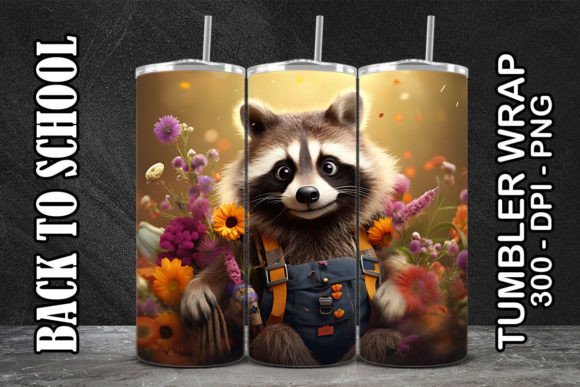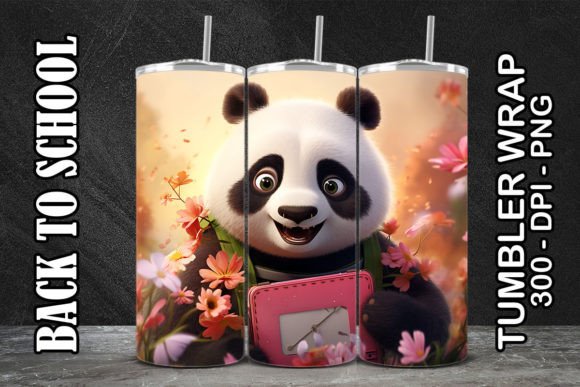
Panda Back to School Tumbler 2: A Digital Design Resource for Custom Sublimation Projects
As back-to-school season approaches, educators, small business owners, and creative professionals increasingly turn to personalized drinkware as both functional tools and expressive branding assets. Among the most practical and widely adopted formats is the 20-ounce tumbler—compact enough for student desks, durable enough for daily classroom use, and versatile enough for promotional giveaways or boutique retail. The Panda Back to School Tumbler 2 isn’t a physical product you hold in your hand—it’s a curated digital design resource built specifically for sublimation printing on cylindrical tumblers with standard dimensions. Understanding its structure, intended workflow, and real-world applicability helps users maximize quality, consistency, and efficiency across diverse applications.
What the Panda Back to School Tumbler 2 Bundle Actually Delivers
The core offering is a single ZIP file containing multiple high-resolution PNG files—each sized at 9.06 inches wide by 8.11 inches tall and rendered at 300 DPI. This precise dimensioning reflects industry-standard sublimation wrap requirements for a typical 20 oz tumbler with a printable surface area of approximately 8.5 inches in height and a circumference that maps cleanly to 9.06 inches when unwrapped. Unlike generic templates or scalable vector files, these PNGs are pre-calibrated raster assets—optimized for clarity, edge fidelity, and color integrity during heat transfer.
Each PNG file within the bundle features the same foundational layout but varies in visual emphasis—some highlight bold panda motifs with school-themed typography (“First Day Ready”, “Math Mode Activated”, “Science Squad”), while others integrate subtle academic icons (graduation caps, open books, pencils) alongside minimalist panda silhouettes. All maintain consistent spacing, bleed zones, and safe margins aligned with common sublimation press tolerances. No fonts are embedded; text elements are rasterized to ensure pixel-perfect reproduction regardless of the user’s local font library or editing software.
Why Raster-Based PNGs Matter for Sublimation Consistency
While SVG or AI files offer scalability, PNGs at 300 DPI provide predictable output when printed onto sublimation paper—a critical factor for repeatable results. Heat presses vary in temperature distribution, dwell time, and pressure calibration. A raster file eliminates rendering discrepancies caused by font substitution, anti-aliasing inconsistencies, or vector path interpretation errors across different RIP (raster image processor) software. In practice, this means a teacher printing 50 tumblers for her homeroom will see identical line weight, shadow depth, and contrast across every unit—no unexpected thinning of panda whiskers or blurring of graduation cap details.
This reliability extends to commercial settings too. A print shop fulfilling orders for a district-wide wellness initiative can batch-process the Panda Back to School Tumbler 2 files without manual adjustments per job. The fixed dimensions also simplify nesting on large-format sublimation sheets, reducing material waste and speeding up production cycles. For hobbyists using desktop-grade presses like the Cricut EasyPress 2 or VEVOR 15x15, the 9.06 × 8.11 sizing avoids awkward cropping or stretching—two frequent pain points when adapting generic designs to curved surfaces.
Real-World Applications Across User Groups
Different audiences leverage this digital asset in distinct but complementary ways:
- Educators and school staff use it to create cohesive classroom sets—matching tumblers for reading groups, lab teams, or mentorship cohorts. One middle school science department printed 36 units with customized labels (“Bio Buddies”, “Chem Crew”, “Physics Pals”) using layered PNG edits in free tools like Photopea, reinforcing identity while supporting hydration goals.
- Small business owners, especially those operating school supply kiosks or local print studios, incorporate the design into seasonal bundles—pairing the tumbler wrap with matching notebook covers or pencil pouches. Its clean aesthetic allows easy rebranding: swapping out background colors or accent elements without redesigning the entire layout.
- Nonprofit organizations running after-school programs have adapted the files for incentive-based participation models. By adding participant names or achievement badges in post-processing, they transform standardized assets into personalized recognition tools—maintaining brand alignment while honoring individual effort.
- Hobbyists and content creators repurpose the base composition for themed variations—overlaying seasonal elements (backpacks for August, snowflakes for December) or integrating curriculum-specific symbols (periodic tables, historical timelines, literary quotes). Because the original layers aren’t locked, thoughtful modifications retain structural integrity.
Technical Considerations Before You Begin
Using the Panda Back to School Tumbler 2 effectively requires awareness of several technical prerequisites:
- Sublimation-ready substrate: The design presumes use on polyester-coated tumblers or ceramic mugs with sublimation-friendly coatings. Aluminum or stainless steel blanks must be verified for compatibility—some require specific primer layers or pre-heating protocols.
- Color management discipline: While the PNGs are sRGB-encoded, monitor calibration significantly impacts how blues, greens, and greys render on final product. Users reporting inconsistent teal tones often discover their display profile wasn’t set to sRGB prior to soft-proofing.
- Bleed and wrap alignment: Though sized precisely, minor shifts can occur during pressing due to blank curvature or paper slippage. Best practice involves printing a test wrap on scrap material first, checking seam alignment at the overlap point (typically marked with a subtle registration dot in the lower-right corner of each PNG).
- Software fluency: Editing beyond basic recoloring—such as inserting custom text or logos—requires comfort with layer masks, transparency handling, and non-destructive adjustment techniques. Tools like GIMP, Affinity Photo, or Adobe Photoshop deliver optimal control, though browser-based editors like Pixlr X suffice for simple hue/saturation tweaks.
How It Fits Within Broader Design and Production Trends
The rise of niche, context-aware digital assets like the Panda Back to School Tumbler 2 reflects a larger shift in creative commerce—from generic clipart repositories toward purpose-built, workflow-integrated resources. Unlike broad “school theme” packs with hundreds of unrelated elements, this bundle focuses tightly on one application: cylindrical sublimation for education-adjacent use cases. That specificity enables deeper optimization—not just in sizing, but in visual hierarchy, negative space planning, and thermal behavior anticipation (e.g., avoiding fine lines directly over seam areas where heat concentration may cause ink migration).
It also aligns with growing demand for ethical, low-waste customization. Because no physical inventory is held or shipped, educators sourcing supplies for remote learning kits reduce carbon footprint while maintaining personalization. Likewise, startups testing market response to branded tumblers avoid minimum order quantities or storage overhead—validating demand through digital mockups and small-batch production before scaling.
Practical Tips for Long-Term Usability
To extend the utility of the Panda Back to School Tumbler 2 beyond a single season, consider these approaches:
- Create variant libraries: Save edited versions as “Panda_Tumbler_Fall2024”, “Panda_Tumbler_Spring2025”, etc., preserving the original files untouched. This builds a reusable archive without risking corruption of source assets.
- Document your process: Note which press settings (time/temperature/pressure) yielded best results on your specific tumbler model. Sublimation performance varies between brands—even among tumblers labeled identically—so empirical data trumps manufacturer recommendations.
- Batch-edit efficiently: Use actions or macros to apply consistent color corrections across all PNGs simultaneously. This ensures uniformity when producing multi-design runs (e.g., one panda per grade level).
- Validate accessibility: Check contrast ratios between foreground elements and background fields using free tools like WebAIM’s Contrast Checker. Sufficient contrast supports students with low vision and improves legibility under varied lighting conditions—especially important in cafeteria or gymnasium settings.
Final Thoughts on Intentional Design Selection
Choosing a digital tumbler wrap isn’t merely about aesthetics—it’s an operational decision with downstream implications for time investment, material yield, brand coherence, and end-user experience. The Panda Back to School Tumbler 2 succeeds not because it’s universally “cute” or “trendy,” but because its constraints are intentional: fixed dimensions rooted in physical reality, raster fidelity prioritized over theoretical scalability, and thematic relevance anchored in observable classroom needs. Whether you’re outfitting a kindergarten circle time station or launching a campus-wide sustainability campaign, selecting assets designed with production pragmatism—and pedagogical context—in mind leads to outcomes that look polished, function reliably, and resonate meaningfully.